Is Titanium Cookware Safe? (Everything You Need to Know)
Cookware safety is no longer a niche concern reserved for professional chefs or nutrition experts. In recent years, more households have begun questioning what actually happens when metal meets heat, moisture, and food, day after day, year after year. Reports about degrading nonstick coatings, concerns about heavy metal exposure, and growing awareness of long-term health risks have pushed many consumers to reevaluate the materials sitting on their stovetops.
When you cook, your cookware doesn’t just hold food, it interacts with it. High temperatures, acidic ingredients, and repeated use can expose weaknesses in certain materials. Some metals may react. Some coatings may deteriorate. And once those reactions begin, microscopic particles or compounds can potentially make their way into the food itself. For health-conscious households, that possibility is enough to raise important questions.
This shift in awareness has led many buyers to explore alternatives that promise greater chemical stability and long-term durability. Among these options, titanium cookware has gained significant attention. Known for its use in aerospace engineering, marine equipment, and even medical implants, titanium carries a reputation for strength, corrosion resistance, and biological compatibility.
But reputation alone isn’t enough when it comes to something as personal as the tools used to prepare daily meals.
Is titanium cookware truly safe for cooking?
Does it release metal into food?
How does it compare to stainless steel, aluminum, or nonstick coatings?
And are all “titanium” products actually made from pure titanium?
This guide takes a detailed, science-based look at titanium cookware safety. We’ll examine how titanium behaves under heat, whether it reacts with food, how it compares to other common cookware materials, and what consumers should understand before making a purchase decision.
By the end, you’ll have a clear, evidence-based understanding of whether titanium cookware is a smart and safe choice for your kitchen.
Why Cookware Safety Matters
Cooking equipment comes into direct contact with food, heat, and moisture, a combination that can trigger chemical reactions in certain materials.
Some cookware materials have raised concerns due to:
-
chemical coatings degrading over time
-
heavy metals leaching into food
-
reactions with acidic ingredients
-
overheating releasing harmful compounds
Because of these risks, buyers are increasingly searching for cookware that is:
✔ non-toxic
✔ chemically stable
✔ corrosion-resistant
✔ free from harmful coatings
Titanium cookware often enters the conversation as a safer alternative.
What Is Titanium?
Titanium is a naturally occurring metal known for its exceptional strength-to-weight ratio and resistance to corrosion. It is widely used in industries where durability and safety are critical, including:
-
medical implants and surgical tools
-
aerospace engineering
-
marine equipment
-
high-performance sports gear
Its use in medical devices is especially significant as titanium is biocompatible, meaning it does not react negatively with the human body.
This property is one reason it is considered safe for food contact.
Is Titanium Food-Safe?
Yes, titanium is widely recognized as food-safe.
The metal is:
-
non-toxic
-
non-reactive
-
resistant to corrosion
-
stable at high temperatures
Because titanium does not react with food or release harmful substances under normal cooking conditions, it is considered a safe material for cookware.
Regulatory bodies and food safety standards recognize titanium as suitable for food contact applications.
Does Titanium Leach Into Food?
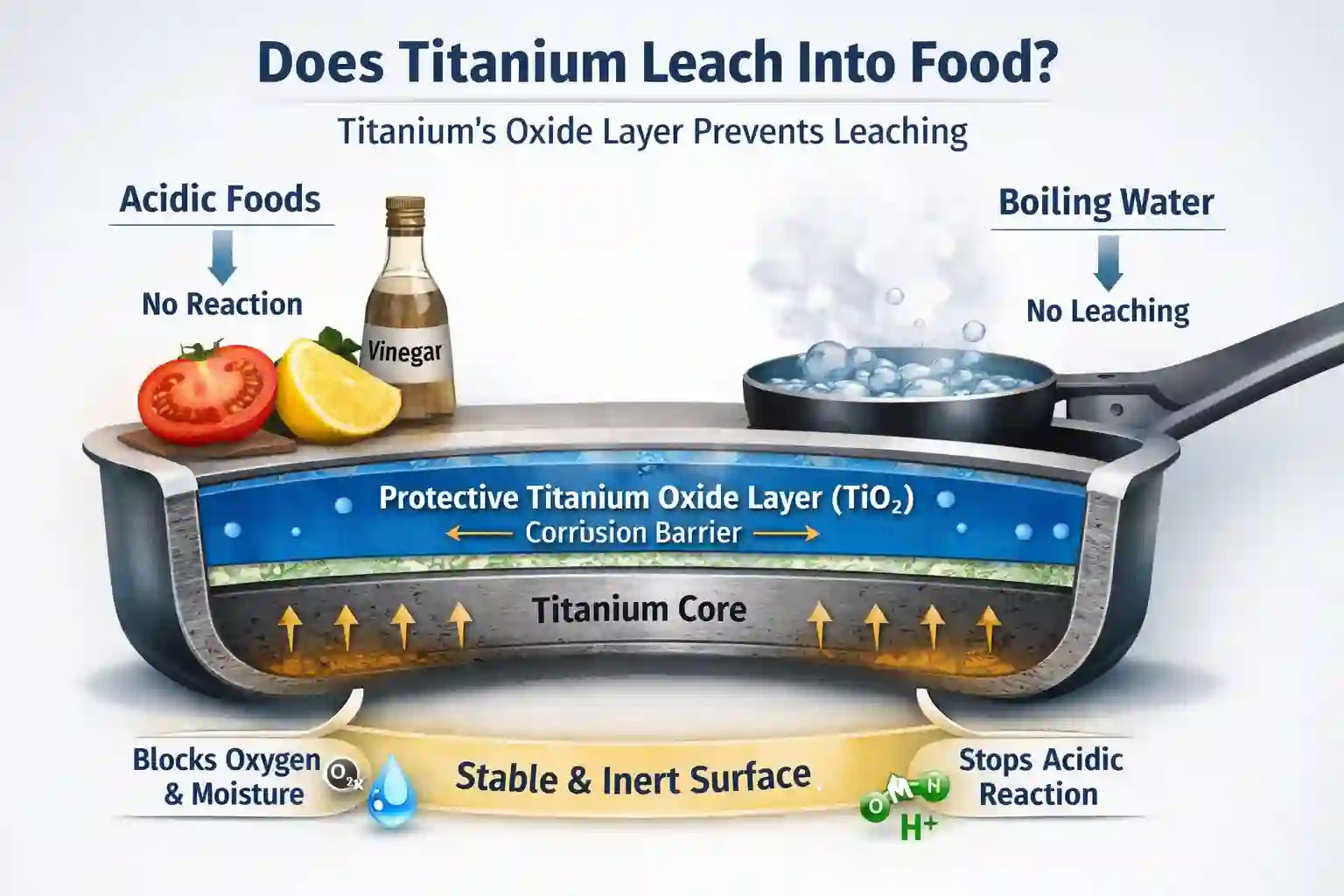
One of the most common concerns about metal cookware is whether microscopic particles or trace metals can migrate into food during cooking. This concern is not unfounded; some metals can react with acidic ingredients, degrade under high heat, or slowly release trace elements over time.
Titanium behaves differently.
When exposed to air, titanium naturally forms an extremely thin but highly stable layer of titanium dioxide (TiO₂) on its surface. This oxide layer develops spontaneously and acts as a passive barrier between the metal and its environment. Unlike protective coatings that can chip, peel, or degrade, this oxide layer is chemically bonded to the metal itself and continuously regenerates if scratched.
This natural passivation layer serves several important functions:
-
It prevents corrosion by blocking oxygen and moisture from reaching the underlying metal.
-
It resists chemical reactions with acidic or alkaline foods.
-
It minimizes ion migration from the metal surface into food.
Because of this stability, titanium is classified as a highly corrosion-resistant and inert material. Under normal cooking conditions — including boiling, steaming, and exposure to acidic foods such as tomatoes, vinegar, or citrus-based sauces — titanium does not leach measurable amounts of metal into food.
Laboratory studies examining metal ion migration have consistently shown titanium to be among the most stable culinary-use metals. Its resistance to leaching is one of the reasons it is used not only in cookware, but also in medical implants, where long-term biological stability is critical.
It is important to note that extreme industrial conditions, such as exposure to highly concentrated acids at elevated pressures, differ significantly from typical kitchen environments. In household cooking scenarios, titanium remains chemically inert and stable.
For everyday culinary use, titanium cookware does not present meaningful leaching concerns.
Is Titanium Non-Toxic?
Titanium is widely regarded as non-toxic and biocompatible, two terms that carry specific scientific meaning.
Non-toxic means that the material does not release harmful substances under normal conditions of use.
Biocompatible means that the human body does not recognize the material as harmful or reactive when it comes into contact with tissues or fluids.
Titanium meets both criteria.
One of the strongest indicators of its safety profile is its long-standing use in medical and surgical applications. Titanium is commonly used in:
-
joint replacements
-
dental implants
-
bone screws and plates
-
surgical instruments
-
cardiovascular devices
These applications require materials that can remain inside the human body for decades without triggering inflammation, corrosion, or toxic reactions. The human body is a far more chemically complex and demanding environment than a kitchen, containing salts, enzymes, temperature fluctuations, and continuous biological activity.
The fact that titanium performs reliably in such conditions demonstrates its exceptional chemical stability and biological neutrality.
This stability is largely due to the same passive oxide layer that prevents corrosion. Titanium does not easily break down, oxidize aggressively, or release reactive compounds. In contrast, some metals can gradually release ions that may accumulate in sensitive individuals over time.
For cookware specifically, this means that pure titanium presents an extremely low toxicological risk under normal culinary conditions. It does not depend on synthetic coatings for safety, nor does it rely on protective layers that may degrade with age.
It is important, however, to distinguish between pure titanium cookware and products marketed as “titanium” that may include nonstick coatings or alloy bases. The non-toxic properties described here apply most directly to solid titanium materials rather than composite or coated cookware systems.
Beyond cookware, titanium is increasingly used in other kitchen applications where food contact safety matters, including storage solutions such as spice containers and ingredient canisters. Because titanium does not react with moisture or acidic residues, it offers a durable and corrosion-resistant option for long-term food storage. If you’re exploring practical kitchen uses beyond pots and pans, see our guide to the best titanium spice containers for everyday and travel-friendly storage.
Overall, from a materials science and toxicology perspective, titanium ranks among the most biologically stable metals used in consumer products today.
Titanium vs Stainless Steel: Which Is Safer?
Stainless steel is one of the most common cookware materials and is generally safe. However, it contains alloy metals such as nickel and chromium.
Stainless Steel
Pros
-
durable and affordable
-
excellent heat retention
-
widely available
Considerations
-
trace nickel release possible (important for sensitive individuals)
-
heavier than titanium
Titanium
Pros
-
completely non-reactive
-
nickel-free
-
lightweight and corrosion-resistant
Considerations
-
lower heat conductivity
-
often more expensive
Safety Verdict: Both are safe, but titanium may be preferable for individuals with nickel sensitivities.
Titanium vs Aluminum Cookware Safety
Aluminum cookware has been widely used due to its affordability and heat conductivity. However, concerns have been raised regarding metal leaching and reactivity.
Aluminum
-
reacts with acidic foods
-
may leach metal into food if uncoated
-
often requires protective coatings
Titanium
-
chemically inert
-
does not react with acidic foods
-
requires no protective coating
Safety Verdict: Titanium is more chemically stable and non-reactive.
Titanium vs Nonstick Cookware
Nonstick pans often rely on synthetic coatings to prevent food from sticking.
Potential concerns include:
-
coating degradation over time
-
overheating releasing fumes
-
scratching, exposing underlying materials
Titanium cookware typically avoids these issues because it relies on the metal’s natural properties rather than chemical coatings.
Some products marketed as “titanium nonstick” still use coatings, which leads to an important distinction.
Not All “Titanium Cookware” Is Pure Titanium
This is one of the most important facts consumers should understand.
Products labeled as titanium cookware may fall into three categories:
1️⃣ Pure Titanium Cookware
-
made entirely from titanium
-
lightweight and corrosion-resistant
-
common in camping and outdoor cookware
2️⃣ Titanium-Reinforced Cookware
-
base metal (often aluminum or steel)
-
titanium added for strength or durability
3️⃣ Titanium-Coated Nonstick Cookware
-
traditional nonstick coating
-
titanium particles added for reinforcement
If safety and chemical stability are priorities, pure titanium cookware is the most straightforward option.
Is Titanium Safe at High Temperatures?
Titanium is exceptionally stable under heat. With a melting point above 3,000°F (approximately 1,650°C), it far exceeds the temperatures encountered in typical household cooking. For context, most stovetop cooking occurs between 250°F and 600°F, while oven baking rarely exceeds 500°F. Even high-heat searing generally stays below 700°F — still well within titanium’s structural tolerance.
However, melting point alone does not define safety. What matters more in cookware applications is whether a material remains chemically stable and structurally intact under repeated heating cycles.
Titanium performs well on both fronts.
When exposed to high temperatures, titanium maintains its mechanical strength and does not break down into reactive compounds. Its naturally forming titanium dioxide (TiO₂) surface layer remains stable, continuing to act as a barrier against corrosion and chemical interaction. Unlike certain coated cookware systems that may degrade or release fumes when overheated, solid titanium does not rely on synthetic layers for heat resistance.
Under normal culinary conditions — including boiling, simmering, baking, and direct stovetop heat — titanium does not release harmful substances or undergo structural degradation.
This high-temperature stability also explains its popularity in outdoor and survival settings. Titanium cookware is frequently used in:
-
boiling water for purification
-
open-flame cooking
-
campfire and backpacking setups
-
lightweight expedition kits
Many backpackers prefer titanium cookware for its lightweight durability and resistance to corrosion in outdoor environments. If you’re specifically looking for trail-ready options, you can explore our guide to the best titanium camping pots for backpacking and campfire use.
In both kitchen and outdoor scenarios, titanium remains chemically inert and structurally reliable, even under repeated exposure to elevated heat.
Does Titanium Affect Food Taste?
Titanium is non-reactive and does not impart flavors or metallic tastes to food.
This neutrality makes it ideal for:
-
delicate soups and broths
-
coffee and tea
-
acidic dishes
-
long simmering meals
Advantages of Titanium Cookware
Beyond safety, titanium cookware offers practical benefits:
✔ extremely lightweight
✔ corrosion-proof
✔ resistant to rust
✔ long lifespan
✔ non-reactive with food
✔ easy to clean
✔ ideal for outdoor cooking
These advantages make it particularly popular among backpackers and minimalist cooks.
Potential Drawbacks to Consider
While titanium cookware is widely regarded as safe and chemically stable, it is not a universal solution for every cooking style or kitchen preference. Like any material, titanium has physical properties that influence how it performs in real-world culinary use.
Understanding these limitations helps buyers make a more informed decision.
Lower Heat Conductivity
One of titanium’s most significant characteristics is its relatively low thermal conductivity compared to materials such as aluminum or copper. In simple terms, titanium does not transfer heat as quickly or as evenly across its surface.
Aluminum and copper are excellent heat conductors, which is why they are often used in professional cookware. Titanium, by contrast, prioritizes strength and corrosion resistance over heat dispersion efficiency.
As a result:
-
Heat may concentrate in localized areas.
-
Temperature adjustments may not spread as rapidly across the cooking surface.
-
Thin titanium cookware can develop hot spots if used on high heat without adequate food or liquid coverage.
For tasks such as boiling water, simmering soups, or reheating meals, this limitation is generally minimal. However, for precise culinary techniques that depend on uniform heat distribution — such as delicate sauces or controlled sautéing — titanium may require closer attention.
Not Ideal for High-Precision Frying
Titanium cookware performs exceptionally well in applications like boiling, steaming, and lightweight outdoor cooking. However, it is less suited for certain stovetop techniques that depend on heat retention and even browning.
Materials such as cast iron and multi-layer stainless steel excel at maintaining consistent surface temperatures during frying or searing. Titanium’s lighter weight and lower heat retention mean that temperature may fluctuate more quickly when food is added to the pan.
For home cooks who prioritize high-heat searing, slow caramelization, or heavy stovetop use, titanium may function better as a complementary tool rather than a primary pan.
That said, for campers, backpackers, and minimalist kitchens focused on portability and simplicity, titanium’s performance is more than adequate.
Higher Cost
Titanium cookware typically carries a higher price point compared to aluminum or standard stainless steel options. This cost reflects several factors:
-
The expense of raw titanium material
-
Complex manufacturing processes
-
Lower production volumes
-
Specialized fabrication techniques
Titanium is more challenging to machine and shape than many common cookware metals, which contributes to its premium positioning in the market.
For some buyers, this cost may be justified by the material’s durability, corrosion resistance, and long lifespan. For others who prioritize affordability or heat performance above all else, alternative materials may provide better value.
[affiai asin=”B0D61ZQRXF,B0GNYV2ZHT” count=”2″ template=”grid”]
Putting the Limitations in Perspective
It is important to note that these drawbacks relate to cooking performance — not safety.
Titanium’s lower thermal conductivity does not impact its chemical stability or biological compatibility. The material remains non-reactive and corrosion-resistant regardless of its heat transfer characteristics.
For buyers whose primary concern is long-term safety, minimal reactivity, and durability — particularly in outdoor or lightweight settings — titanium remains a highly reliable choice.
For those seeking professional-level heat precision, layered stainless steel or copper-based cookware may better suit their needs.
Who Should Consider Titanium Cookware?
Titanium cookware is especially suitable for:
-
health-conscious households
-
individuals with metal sensitivities
-
backpackers and campers
-
minimalist kitchens
-
travelers and outdoor enthusiasts
Those who prioritize durability and safety over heat performance may benefit most.
Frequently Asked Questions
1. Is titanium cookware safer than stainless steel?
Both titanium and stainless steel are considered safe for cooking under normal conditions. However, titanium is completely nickel-free and highly inert, which may make it preferable for individuals with nickel sensitivities or concerns about metal reactivity. Stainless steel remains widely used and safe, but trace nickel release is possible in certain conditions. From a chemical stability standpoint, titanium is among the most inert options available.
2. Can titanium cookware rust?
No. Titanium is highly resistant to corrosion and does not rust like iron-based metals. Its naturally forming oxide layer protects the surface from moisture and oxygen exposure. Even in humid environments or outdoor conditions, titanium cookware maintains its structural integrity without developing rust.
3. Is titanium cookware safe for acidic foods?
Yes. Titanium is non-reactive and does not chemically interact with acidic ingredients such as tomatoes, citrus, vinegar, or wine. Unlike aluminum, which can react with acidic foods, titanium remains stable and does not impart flavor or release metal into the dish.
4. Is titanium cookware safe at high temperatures?
Titanium has an extremely high melting point (over 3,000°F / 1,650°C), far exceeding typical household cooking temperatures. Under normal culinary use, titanium remains structurally stable and does not release harmful substances when exposed to high heat. It is commonly used in open-flame and campfire cooking due to its durability.
5. Is pure titanium cookware better than titanium-coated cookware?
Pure titanium cookware offers the most straightforward safety profile because the cooking surface is solid titanium. Titanium-coated or titanium-infused cookware may still rely on nonstick coatings or alloy bases beneath the surface. When safety and chemical stability are primary concerns, solid titanium cookware provides greater clarity regarding material composition.
Final Verdict: Is Titanium Cookware Safe?
Based on current materials science understanding and long-term real-world use, titanium cookware is widely regarded as safe for cooking.
Its safety rests on three fundamental characteristics: chemical inertness, corrosion resistance, and biological compatibility. Titanium does not readily react with food, does not meaningfully leach into meals under normal cooking conditions, and remains structurally stable even when exposed to high heat or acidic ingredients. Unlike some cookware systems that rely on synthetic coatings for protection, solid titanium derives its stability from its own naturally forming oxide layer.
From a toxicological perspective, titanium’s extensive use in medical implants further supports its classification as a low-risk material. While the human body presents a far more demanding chemical environment than any kitchen, titanium performs reliably in both settings due to its resistance to corrosion and ion migration.
That said, it is important to approach the category thoughtfully. Not all products labeled “titanium cookware” are made from pure titanium. Some may use titanium-reinforced alloys or titanium-infused nonstick coatings. When evaluating safety, the underlying construction of the cookware matters. Solid titanium cookware offers the clearest and most direct safety profile.
In practical terms, titanium cookware may not be the perfect solution for every cooking technique. It does not distribute heat as evenly as copper or aluminum, and it may not replace heavier materials like cast iron for certain culinary styles. However, when safety, durability, and chemical stability are the primary priorities, titanium stands out as one of the most reliable options available.
For individuals seeking a lightweight, corrosion-resistant, and biologically stable cookware material — particularly for outdoor use, minimalist kitchens, or long-term durability — titanium remains one of the safest and most stable choices on the market today.

Andrea
Related Posts
8 Best Titanium Kitchen Knives in 2026
8 Best Titanium Tea Kettles in 2026